 Worldlex Wiki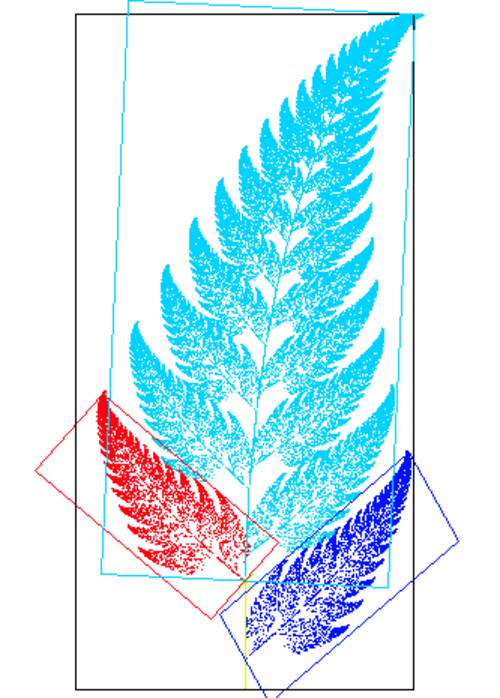
In Euclidean geometry, an affine transformation or affinity (from the Latin, affinis, "connected with") is a geometric transformation that preserves lines and parallelism, but not necessarily Euclidean distances and angles.
More generally, an affine transformation is an automorphism of an affine space (Euclidean spaces are specific affine spaces), that is, a function which maps an affine space onto itself while preserving both the dimension of any affine subspaces (meaning that it sends points to points, lines to lines, planes to planes, and so on) and the ratios of the lengths of parallel line segments. Consequently, sets of parallel affine subspaces remain parallel after an affine transformation. An affine transformation does not necessarily preserve angles between lines or distances between points, though it does preserve ratios of distances between points lying on a straight line.
If can be represented as the composition of a linear transformation on . Unlike a purely linear transformation, an affine transformation need not preserve the origin of the affine space. Thus, every linear transformation is affine, but not every affine transformation is linear.
Examples of affine transformations include translation, scaling, homothety, similarity, reflection, rotation, hyperbolic rotation, shear mapping, and compositions of them in any combination and sequence.
Viewing an affine space as the complement of a hyperplane at infinity of a projective space, the affine transformations are the projective transformations of that projective space that leave the hyperplane at infinity invariant, restricted to the complement of that hyperplane.
A generalization of an affine transformation is an affine map (or affine homomorphism or affine mapping) between two (potentially different) affine spaces over the same field and be two affine spaces with the point sets and the respective associated vector spaces over the field : X → Z is an affine map if there exists a linear map: V → W such that for all .
Definition
Let , and from from is well defined by the equation
If the dimension of of onto itself satisfying:
- For every -dimensional affine subspace, then is also a -dimensional affine subspace of and , then and are parallel.
These two conditions are satisfied by affine transformations, and express what is precisely meant by the expression that " has at least three elements, the first condition can be simplified to: acts on in there is associated a point . We can denote this action by . For any : V → X given by
 in there is associated a point . We can denote this action by . For any : V → X given by
 This vector space has origin , but common practice is to denote it by the same symbol and mention that it is a vector space after an origin has been specified. This identification permits points to be viewed as vectors and vice versa.
For any linear transformation, we can define the function : X → X by
Then is an affine transformation of fixed. It is a linear transformation of .
Let . Pick a point and consider the translation of , denoted by . Translations are affine transformations and the composition of affine transformations is an affine transformation. For this choice of of That is, an arbitrary affine transformation of (viewed as a vector space) and a translation of and the translation as the addition of a vector
 , denoted by . Translations are affine transformations and the composition of affine transformations is an affine transformation. For this choice of of
  That is, an arbitrary affine transformation of (viewed as a vector space) and a translation of
  and the translation as the addition of a vector
 Augmented matrix
Using an augmented matrix and an augmented vector, it is possible to represent both the translation and the linear map using a single matrix multiplication. The technique requires that all vectors be augmented with a "1" at the end, and all matrices be augmented with an extra row of zeros at the bottom, an extra column—the translation vector—to the right, and a "1" in the lower right corner. If
is equivalent to the following
The above-mentioned augmented matrix is called an affine transformation matrix. In the general case, when the last row vector is not restricted to be
This representation exhibits the set of all invertible affine transformations as the semidirect product of
Ordinary matrix-vector multiplication always maps the origin to the origin, and could therefore never represent a translation, in which the origin must necessarily be mapped to some other point. By appending the additional coordinate "1" to every vector, one essentially considers the space to be mapped as a subset of a space with an additional dimension. In that space, the original space occupies the subset in which the additional coordinate is 1. Thus the origin of the original space can be found at
The advantage of using homogeneous coordinates is that one can combine any number of affine transformations into one by multiplying the respective matrices. This property is used extensively in computer graphics, computer vision and robotics.
Example augmented matrix
Suppose you have three points that define a non-degenerate triangle in a plane, or four points that define a non-degenerate tetrahedron in 3-dimensional space, or generally points , ..., that define a non-degenerate simplex in , ..., , where these new points can lie in a space with any number of dimensions. (Furthermore, the new points need not form a non-degenerate simplex, nor even be distinct from each other.) The unique augmented matrix for every using matrix inversion.
 for every
  using
using Properties
Properties preserved
An affine transformation preserves:
- collinearity between points: three or more points which lie on the same line (called collinear points) continue to be collinear after the transformation.
- parallelism: two or more lines which are parallel, continue to be parallel after the transformation.
- convexity of sets: a convex set continues to be convex after the transformation. Moreover, the extreme points of the original set are mapped to the extreme points of the transformed set.
- ratios of lengths of parallel line segments: for distinct parallel segments defined by points
- barycenters of weighted collections of points.
Groups
As an affine transformation is invertible, the square matrix
The invertible affine transformations (of an affine space onto itself) form the affine group, which has the general linear group of degree
The similarity transformations form the subgroup where
Each of these groups has a subgroup of orientation-preserving or positive affine transformations: those where the determinant of
If there is a fixed point, we can take that as the origin, and the affine transformation reduces to a linear transformation. This may make it easier to classify and understand the transformation. For example, describing a transformation as a rotation by a certain angle with respect to a certain axis may give a clearer idea of the overall behavior of the transformation than describing it as a combination of a translation and a rotation. However, this depends on application and context.
Affine maps
An affine map
We can interpret this definition in a few other ways, as follows.
If an origin
If an origin
The conclusion is that, intuitively,
Alternative definition
Given two affine spaces
Example
Let
History
The word "affine" as a mathematical term is defined in connection with tangents to curves in Euler's 1748 Introductio in analysin infinitorum.Felix Klein attributes the term "affine transformation" to Möbius and Gauss.
Image transformation
In their applications to digital image processing, the affine transformations are analogous to printing on a sheet of rubber and stretching the sheet's edges parallel to the plane. This transform relocates pixels requiring intensity interpolation to approximate the value of moved pixels, bicubic interpolation is the standard for image transformations in image processing applications. Affine transformations scale, rotate, translate, mirror and shear images as shown in the following examples:
with with
with In plane geometry


In
Transforming the three corner points of the original triangle (in red) gives three new points which form the new triangle (in blue). This transformation skews and translates the original triangle.
In fact, all triangles are related to one another by affine transformations. This is also true for all parallelograms, but not for all quadrilaterals.