 Worldlex Wiki
Humiliation is the abasement of pride, which creates mortification or leads to a state of being humbled or reduced to lowliness or submission. It is an emotion felt by a person whose social status, either by force or willingly, has just decreased. It can be brought about through intimidation, physical or mental mistreatment or trickery, or by embarrassment if a person is revealed to have committed a socially or legally unacceptable act. Whereas humility can be sought alone as a means to de-emphasize the ego, humiliation must involve other person(s), though not necessarily directly or willingly.
Humiliation is currently an active research topic, and is now seen as an important – and complex – core dynamic in human relationships, having implications at intrapersonal, interpersonal, institutional and international levels.
Psychological effects
Une personne victime d'humiliation grave peut souffrir de dépression majeure , d'idées suicidaires et de troubles anxieux sévères, comme le syndrome de stress post-traumatique . La perte de statut, telle que la perte d'un emploi ou le fait d'être traité de menteur ou discrédité injustement, peut empêcher les individus d'adopter un comportement normal au sein de leur communauté. Les personnes humiliées peuvent être provoquées et avoir soif de vengeance ; certaines peuvent se sentir inutiles, désespérées et impuissantes, ce qui peut engendrer des pensées suicidaires si justice n'est pas rendue. L'humiliation peut également mener à de nouvelles prises de conscience, à un engagement militant et à une nouvelle solidarité avec les groupes marginalisés.
Le sentiment d'humiliation peut engendrer une « fureur humiliée » , qui, lorsqu'elle est retournée contre soi, peut mener à l'apathie et à la dépression , et, lorsqu'elle est retournée contre soi, peut provoquer de la paranoïa , des comportements sadiques et des fantasmes de vengeance. Klein explique : « Lorsqu'elle est dirigée vers l'extérieur, la fureur humiliée crée malheureusement des victimes supplémentaires, souvent parmi lesquelles des passants innocents. Lorsqu'elle est retournée contre soi, la haine de soi qui en résulte rend les victimes incapables de satisfaire leurs propres besoins, et encore moins d'avoir l'énergie nécessaire pour aimer et prendre soin des autres. »
Une étude menée par des chercheurs de l' Université du Michigan a révélé que « les mêmes régions du cerveau qui s'activent en réponse à des expériences sensorielles douloureuses sont activées lors d'expériences intenses de rejet social ». En d'autres termes, l'humiliation et la solitude sont vécues avec autant d'intensité que la douleur physique.
Sanctions et techniques d'interrogatoire

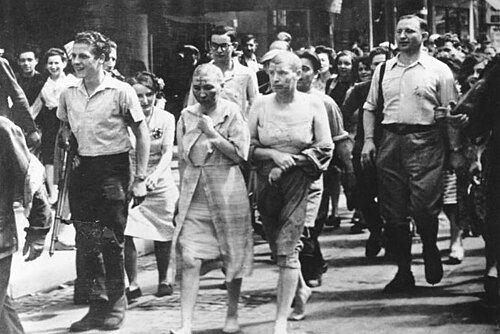
Humiliation of one person by another (the humiliator) is often used as a way of asserting power over them, and is a common form of oppression or abuse used in a police, military, or prison context during legal interrogations or illegal torture sessions. Many now-obsolete public punishments were deliberately designed to be humiliating, e.g. tarring and feathering lawbreakers, pillory, "mark of shame" (stigma) as a means of "making an example" of a person and presenting a deterrent to others. Some practices, such as tarring and feathering, became tools of unofficial mob justice. In folk customs such as the English skimmington rides and rough music (and their continental equivalents, such as the French Charivari), dramatic public demonstrations of moral disapproval were enacted to humiliate transgressors and drive them out of the community.
Some U.S. states have experimented with humiliating or shaming lawbreakers by publishing their names and indicating their offense (e.g., with soliciting prostitutes or drinking and driving). In 2010, there was public outcry about reports showing police in Dongguan and Guangdong in China leading a parade of arrested prostitutes for the purpose of humiliating them. The national Ministry of Public Security reprimanded the local police and affirmed that such punishments are not allowed.
A wider human perspective

Donald Klein described humiliation as "a powerful factor in human affairs that has, for a variety of reasons, been overlooked by students of individual and collective behavior. It is a pervasive and all too destructive influence in the behavior of individuals, groups, organizations, and nations."
Though it is a subjective emotion, humiliation has a universal aspect which applies to all human beings: "it is the feeling of being put down, made to feel less than one feels oneself to be."
A society that suffers from humiliation is an unstable one. The cognitive dissonance between the way in which the society is perceived and the way in which it sees itself can be so great that violence can result on a massive scale against people belonging to an out group. According to Jonathan Sacks, "By turning the question 'What did we do wrong?' into 'Who did this to us?', [hate against an out group] restores some measure of self-respect and provides a course of action. In psychiatry, the clinical terms for this process are splitting and projection; it allows people to define themselves as victims."