 Worldlex Wiki
The NASA Mars Design Reference Mission ("DRM") refer to a series of NASA conceptual design studies of the missions to send humans to Mars. The related term, Design Reference Architecture (DRA), refers to the entire sequences of missions and supporting infrastructure.
These are a reference baseline studies summarizing the current technology and possible approaches for a human mission to Mars, and are not actual mission program. According to NASA, the documents "represent a 'snapshot' of work in progress in support of planning for future human exploration of the Martian surface." The design reference missions are used for technology trade studies, to analyze the effect of different approaches to the mission.
Reference Design Mission (1993)

The first Mars Design Reference Mission was a NASA study completed in May 1993, under the auspices of the Space Exploration Initiative (SEI). The objective was to develop a "Reference Mission" based on previous studies and data, where the Reference Mission serves as a basis for comparing different approaches and criteria from future studies.
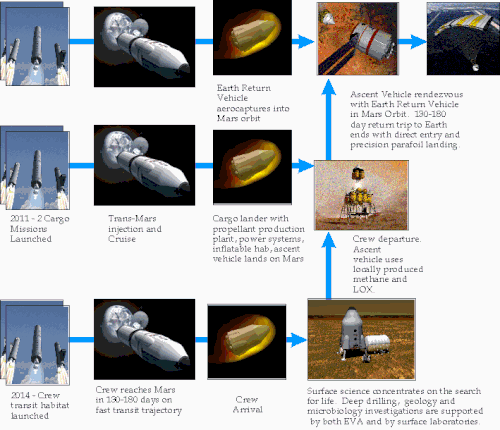
The study was based on Robert Zubrin's Mars Direct mission design. Thus dubbed Mars Semi-Direct by Zubrin, it also made several significant changes, for instance accounting for a larger crew and a dedicated Mars Ascent Vehicle that was to do an Apollo-style Mars-orbit rendezvous with the Earth Return Vehicle, which was to remain in orbit. The Design Reference Mission replaced the preceding SEI as the standing mission plan.
Approach and results
- Limit the time that the crew is exposed to the harsh space environment by employing fast transits to and from Mars and abort to the surface strategy
- Utilize local resources to reduce mission mass
- Use split-mission strategy to pre-deploy mission hardware to reduce mass and minimize risk to the crew
- Examine three human missions to Mars beginning in 2009
- Utilize advanced space propulsion (e.g., nuclear thermal propulsion) for in-space transportation
- Payloads sent directly to Mars using a large launch vehicle (200+ t to LEO)
- Nuclear surface power for robust continuous power
The conclusions of the study were that the total mission mass was approximately 900 metric tons for the first crew (3 cargo vehicles, 1 piloted vehicle). The study pointed out that development of the large launch vehicle is a long-lead and expensive system, and approaches using smaller launch vehicles should be investigated.
Design Reference Mission 2.0
In 1997 a NASA Mars Exploration Study Team was put together and made a more detailed version of the original design reference mission. The plan describes the first human missions to Mars with concept of operations and technologies to be used as a first cut at an architecture. According to the report:
Personnel representing several NASA field centers have formulated a "Reference Mission" addressing human exploration of Mars. This report summarizes their work and describes a plan for the first human missions to Mars, using approaches that are technically feasible, have reasonable risks, and have relatively low costs. The architecture for the Mars Reference Mission builds on previous work of the Synthesis Group (1991) and Zubrin's (1991) concepts for the use of propellants derived from the Martian Atmosphere. In defining the Reference Mission, choices have been made. In this report, the rationale for each choice is documented; however, unanticipated technology advances or political decisions might change the choices in the future.
According to Portree "Subsequent DRM evolution focused on minimizing spacecraft weight in an effort to reduce estimated mission cost." Although not officially given a designation "2.0", the 1997 "scrubbed" (that is, mass reduced) version is referred to by the designation 2.0 in later documents.
Design Reference Mission 3.0