 Worldlex Wiki
 In the context of classical mechanics simulations and physics engines employed within video games, collision response deals with models and algorithms for simulating the changes in the motion of two solid bodies following collision and other forms of contact.
Rigid body contact
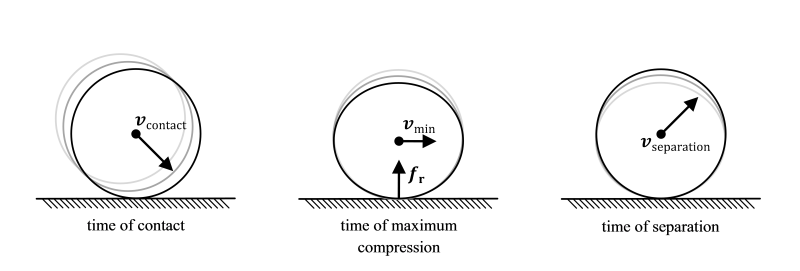
Two rigid bodies in unconstrained motion, potentially under the action of forces, may be modelled by solving their equations of motion using numerical integration techniques. On collision, the kinetic properties of two such bodies seem to undergo an instantaneous change, typically resulting in the bodies rebounding away from each other, sliding, or settling into relative static contact, depending on the elasticity of the materials and the configuration of the collision.
Contact forces
The origin of the rebound phenomenon, or reaction, may be traced to the behaviour of real bodies that, unlike their perfectly rigid idealised counterparts, do undergo minor compression on collision, followed by expansion, prior to separation. The compression phase converts the kinetic energy of the bodies into potential energy and to an extent, heat. The expansion phase converts the potential energy back to kinetic energy.
During the compression and expansion phases of two colliding bodies, each body generates reactive forces on the other at the points of contact, such that the sum reaction forces of one body are equal in magnitude but opposite in direction to the forces of the other, as per the Newtonian principle of action and reaction. If the effects of friction are ignored, a collision is seen as affecting only the component of the velocities that are directed along the contact normal and as leaving the tangential components unaffected
Reaction
The degree of relative kinetic energy retained after a collision, termed the restitution, is dependent on the elasticity of the bodies‟ materials. The coefficient of restitution between two given materials is modeled as the ratio
Friction
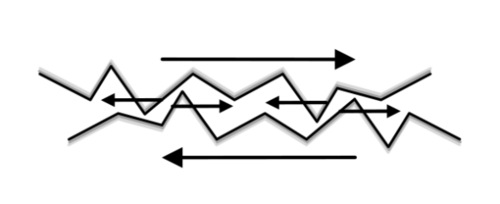
Another important contact phenomenon is surface-to-surface friction, a force that impedes the relative motion of two surfaces in contact, or that of a body in a fluid. In this section we discuss surface-to-surface friction of two bodies in relative static contact or sliding contact. In the real world, friction is due to the imperfect microstructure of surfaces whose protrusions interlock into each other, generating reactive forces tangential to the surfaces.
To overcome the friction between two bodies in static contact, the surfaces must somehow lift away from each other. Once in motion, the degree of surface affinity is reduced and hence bodies in sliding motion tend to offer lesser resistance to motion. These two categories of friction are respectively termed static friction and dynamic friction.
Applied force
It is a force which is applied to an object by another object or by a person. The direction of the applied force depends on how the force is applied.
Normal force
It is the support force exerted upon an object which is in contact with another stable object. Normal force is sometimes referred to as the pressing force since its action presses the surface together. Normal force is always directed towards the object and acts perpendicularly with the applied force.
Frictional force
It is the force exerted by a surface as an object moves across it or makes an effort to move across it. The friction force opposes the motion of the object. Friction results when two surfaces are pressed together closely, causing attractive intermolecular forces between the molecules of the two different surface. As such, friction depends upon the nature of the two surfaces and upon the degree to which they are pressed together. Friction always acts parallel to the surface in contact and opposite the direction of motion. The friction force can be calculated using the equation.
Impulse-based contact model
A force
Pour une impulsion fixe
existe et est égal à
Modèle de réaction basé sur l'impulsion

L'effet de la force de réaction
Par déduction du principe d'action et de réaction, si l'impulsion de collision appliquée par le premier corps sur le second corps au point de contact
En supposant l'amplitude de l'impulsion de collision
où, pour le
De même pour les vitesses angulaires
où, pour le
Les vitesses
pour
En substituant les équations (1a), (1b), (2a), (2b) et (3) dans l'équation (4) et en résolvant pour l'amplitude de l'impulsion de réaction
Calcul de la réaction basée sur l'impulsion
Ainsi, la procédure de calcul des vitesses linéaires après collision
- Calculer l'amplitude de l'impulsion de réaction
- Calculer le vecteur d'impulsion de réaction
- Calculer les nouvelles vitesses linéaires
- Calculer les nouvelles vitesses angulaires
Modèle de frottement basé sur l'impulsion
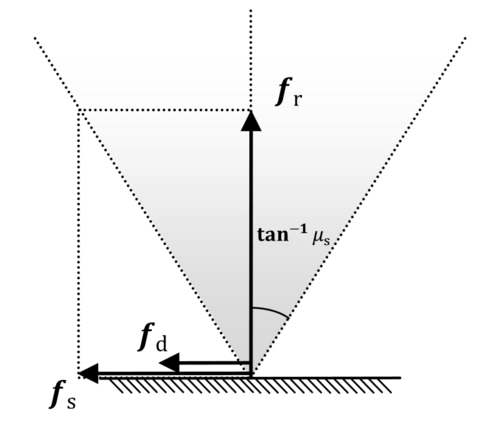
L'un des modèles les plus utilisés pour décrire le frottement est le modèle de Coulomb . Ce modèle définit les coefficients de frottement statique.
La valeur
Le modèle de frottement de Coulomb définit un
où
Les équations (6a), (6b), (7) et (8) décrivent le modèle de frottement de Coulomb en termes de forces. En adaptant le raisonnement pour les impulsions instantanées, on peut dériver une version du modèle de frottement de Coulomb basée sur les impulsions, reliant une impulsion de frottement
où
Les équations (5) et (10) définissent un modèle de contact impulsionnel idéal pour les simulations impulsionnelles. Lors de l'utilisation de ce modèle, il convient d'être vigilant quant au choix de