 Worldlex Wiki
 Multivariable calculus may be thought of as an elementary part of calculus on Euclidean space. The special case of calculus in three dimensional space is often called vector calculus.
domain is therefore multi-dimensional. Care is therefore required in these generalizations, because of two key differences between 1D and higher dimensional spaces:- There are infinite ways to approach a single point in higher dimensions, as opposed to two (from the positive and negative direction) in 1D;
- There are multiple extended objects associated with the dimension; for example, a 1D function is represented as a curve on the 2D Cartesian plane, but a scalar-valued function of two variables is a surface in 3D, while curves can also live in 3D space.
The consequence of the first difference is the difference in the definition of the limits and continuity. Directional limits and derivatives define the limit and differential along a 1D parametrized curve, reducing the problem to the 1D case. Further higher-dimensional objects can be constructed from these operators.
The consequence of the second difference is the existence of multiple types of integration, including line integrals, surface integrals and volume integrals. Due to the non-uniqueness of these integrals, an antiderivative or indefinite integral cannot be properly defined.
Limits
A study of limits and continuity in multivariable calculus yields many counterintuitive results not demonstrated by single-variable functions.
A limit along a path may be defined by considering a parametrised path
Note that the value of this limit can be dependent on the form of
If the point
La limite le long du chemin sera alors :
En revanche, si le chemin (ou paramétriquement, ) est choisi, alors la limite devient :
Comme différents chemins menant à un même point donnent des valeurs différentes, il est impossible de définir une limite générale en ce point pour la fonction.
On peut définir une limite générale si les limites en un point le long de tous les chemins possibles convergent vers la même valeur ; autrement dit, on dit pour une fonction que la limite de en un point est L si et seulement si
pour toutes les fonctions continues telles que .
Continuité
À partir du concept de limite le long d'un chemin, on peut alors déduire la définition de la continuité multivariée de la même manière, c'est-à-dire : on dit qu'une fonction est continue au point si et seulement si
pour toutes les fonctions continues telles que .
Comme pour les limites, la continuité le long d'un chemin n'implique pas la continuité multivariée.
La continuité de chaque argument n'étant pas suffisante pour la continuité multivariée, on peut également le constater dans l'exemple suivant. Par exemple, pour une fonction à valeurs réelles avec deux paramètres à valeurs réelles, , la continuité de dans pour fixé et la continuité de dans pour fixé n'impliquent pas la continuité de .
Considérer
Il est facile de vérifier que cette fonction est nulle par définition sur la frontière et à l'extérieur du quadrilatère . De plus, les fonctions définies pour des constantes et par
sont continues. Plus précisément,
Cependant, considérons le chemin paramétrique . La fonction paramétrique devient
0\\0&{ ext{partout ailleurs}}.\end{casesDonc,
Il est donc clair que la fonction n'est pas continue multivariée, bien qu'elle soit continue dans les deux coordonnées.
Théorèmes relatifs aux limites multivariées et à la continuité
- Toutes les propriétés de linéarité et de superposition du calcul à une variable se retrouvent dans le calcul à plusieurs variables.
- Composition : Si et sont toutes deux des fonctions continues multivariées aux points et respectivement, alors est également une fonction continue multivariée au point .
- Multiplication : Si et sont toutes deux des fonctions continues au point , alors est continue en , et est également continue en à condition que .
- Si f est une fonction continue au point , alors f est également continue au même point.
- Si est lipschitzienne (avec les espaces normés appropriés si nécessaire) au voisinage du point , alors est multivariée continue en .
où est la constante de Lipschitz. Notons également que, comme est continue en , pour tout , il existe tel que .
 0
0  0
0 Par conséquent, pour tout , choisissons ; il existe un tel que pour tout satisfaisant , , et . Ainsi, converge vers quelle que soit la forme précise de . 0" 
Différenciation
En utilisant l'extension des limites évoquée ci-dessus, on peut alors étendre la définition de la dérivée à une fonction à valeurs scalaires le long d'un certain chemin :
Contrairement aux limites, dont la valeur dépend de la forme exacte du chemin , on peut montrer que la dérivée le long du chemin ne dépend que du vecteur tangent du chemin en , c'est-à-dire , à condition que soit lipschitzienne en , et que la limite existe pour au moins un tel chemin.
développement de Taylor de autour de en utilisant le théorème de Taylor pour construire le reste :où .
En substituant ceci dans 10 ,
où .
La continuité lipschitzienne nous donne , pour un certain fini , . Il s'ensuit que .
Notez également que étant donné la continuité de , comme .
En substituant ces deux conditions dans 12 ,
dont la limite ne dépend que de comme terme dominant.
Il est donc possible de généraliser la définition de la dérivée directionnelle comme suit : la dérivée directionnelle d'une fonction scalaire le long du vecteur unitaire en un point donné est
ou, exprimé en termes de différentiation ordinaire,
qui est une expression bien définie car est une fonction scalaire avec une variable dans .
Il est impossible de définir une dérivée scalaire unique sans lui préciser de direction ; il est clair, par exemple, que … Il est également possible que des dérivées directionnelles existent pour certaines directions, mais pas pour d’autres.
Dérivée partielle
On peut considérer une dérivée partielle comme la dérivée directionnelle de la fonction le long d'un axe de coordonnées.
Les dérivées partielles peuvent être combinées de manière intéressante pour créer des expressions plus complexes de la dérivée. En calcul vectoriel , l' opérateur del (→ ) est utilisé pour définir les concepts de gradient , de divergence et de rotationnel à l'aide des dérivées partielles. Une matrice de dérivées partielles, la matrice jacobienne , permet de représenter la dérivée d'une fonction entre deux espaces de dimension quelconque. La dérivée peut ainsi être vue comme une transformation linéaire qui varie directement d'un point à l'autre du domaine de la fonction.
Les équations différentielles contenant des dérivées partielles sont appelées équations aux dérivées partielles ou EDP. Ces équations sont généralement plus difficiles à résoudre que les équations différentielles ordinaires , qui ne contiennent de dérivées que par rapport à une seule variable.
Intégration multiple
L' intégrale de surface et l' intégrale de ligne sont utilisées pour intégrer sur des variétés courbes telles que les surfaces et les courbes .
Théorème fondamental du calcul en dimensions multiples
En calcul différentiel à une variable, le théorème fondamental établit un lien entre la dérivée et l'intégrale. Ce lien, en calcul différentiel à plusieurs variables, est concrétisé par les théorèmes intégraux du calcul vectoriel :
Dans une étude plus avancée du calcul multivariable, on constate que ces quatre théorèmes sont des incarnations spécifiques d'un théorème plus général, le théorème de Stokes généralisé , qui s'applique à l'intégration des formes différentielles sur les variétés .
Applications et utilisations
Les techniques du calcul multivariable sont utilisées pour étudier de nombreux objets d'intérêt dans le monde matériel. En particulier,
| Type de fonctions | Techniques applicables | ||
|---|---|---|---|
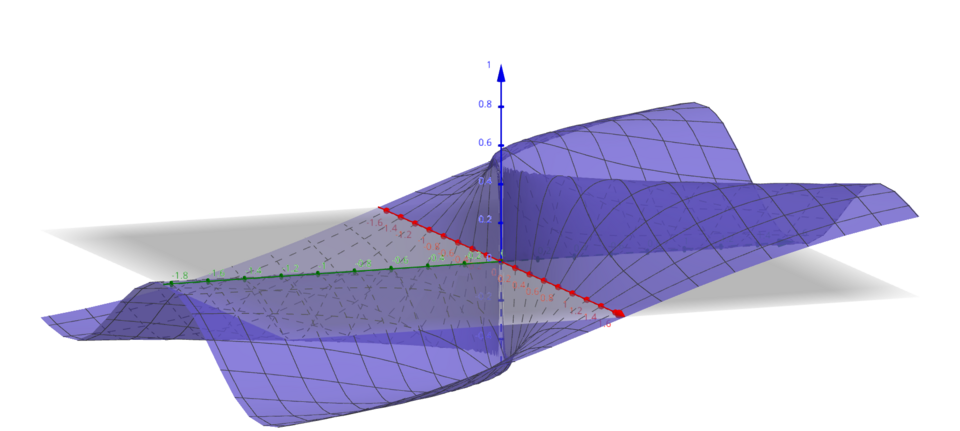
| Courbes | 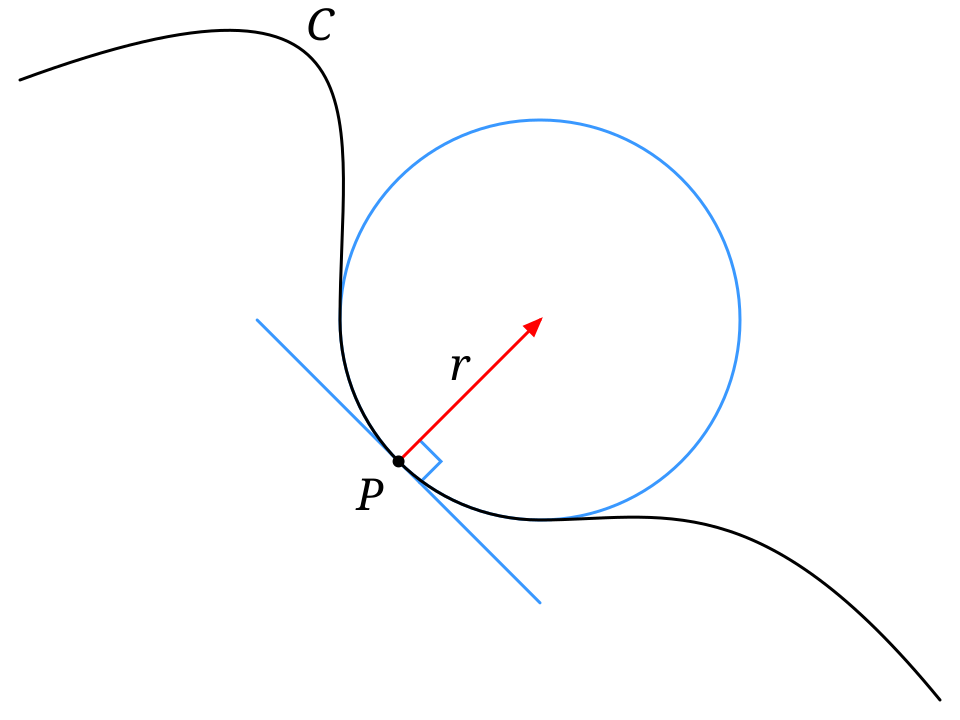 | Longueurs des courbes, intégrales de ligne et courbure . | |
| Surfaces | 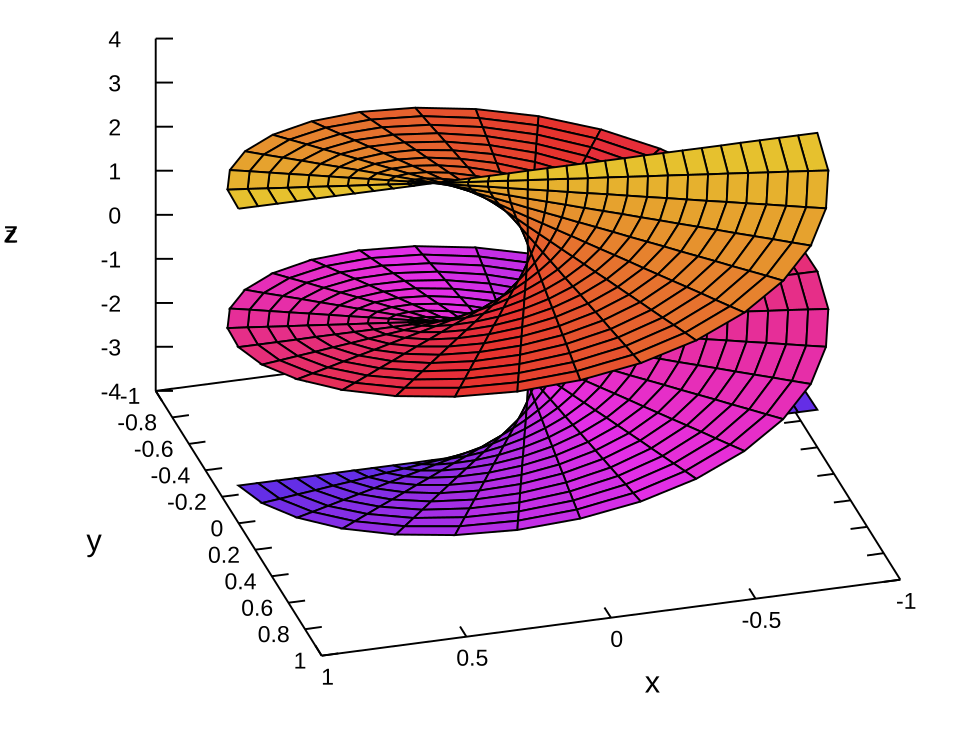 | Aires des surfaces, intégrales de surface , flux à travers les surfaces et courbure. | |
| Champs scalaires | 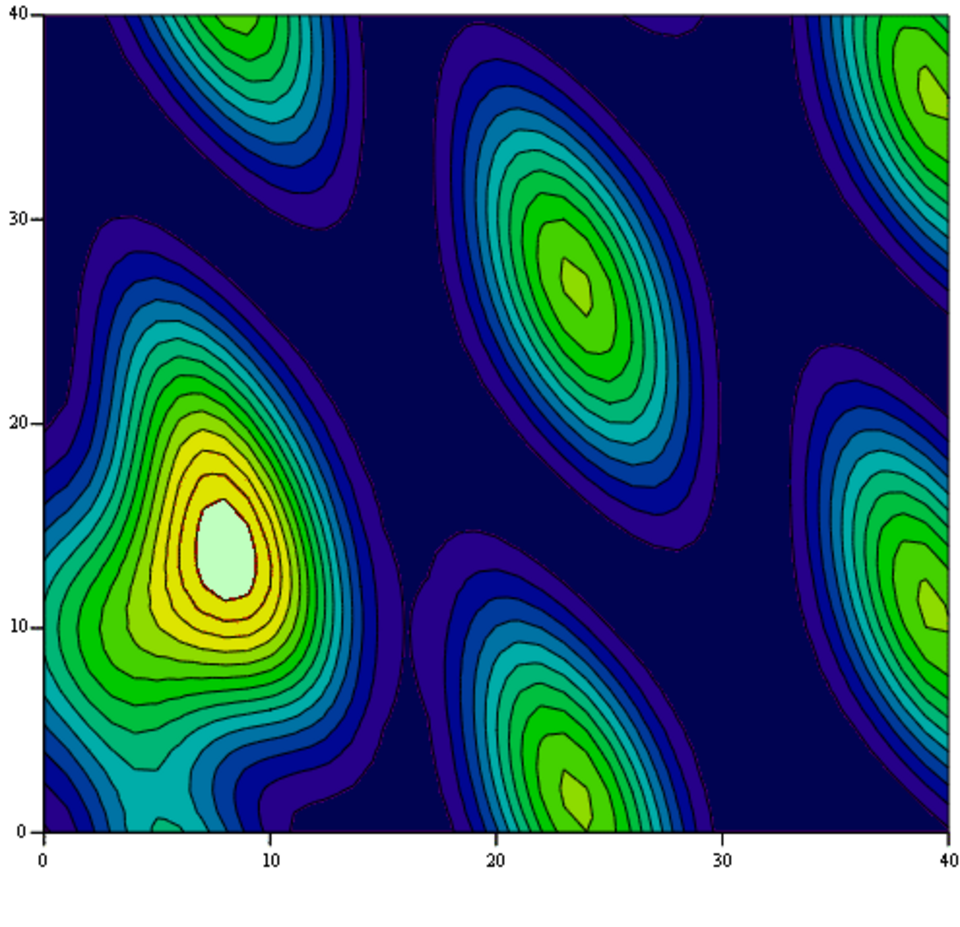 | Maximums et minimums, multiplicateurs de Lagrange , dérivées directionnelles , ensembles de niveau . | |
| champs vectoriels | 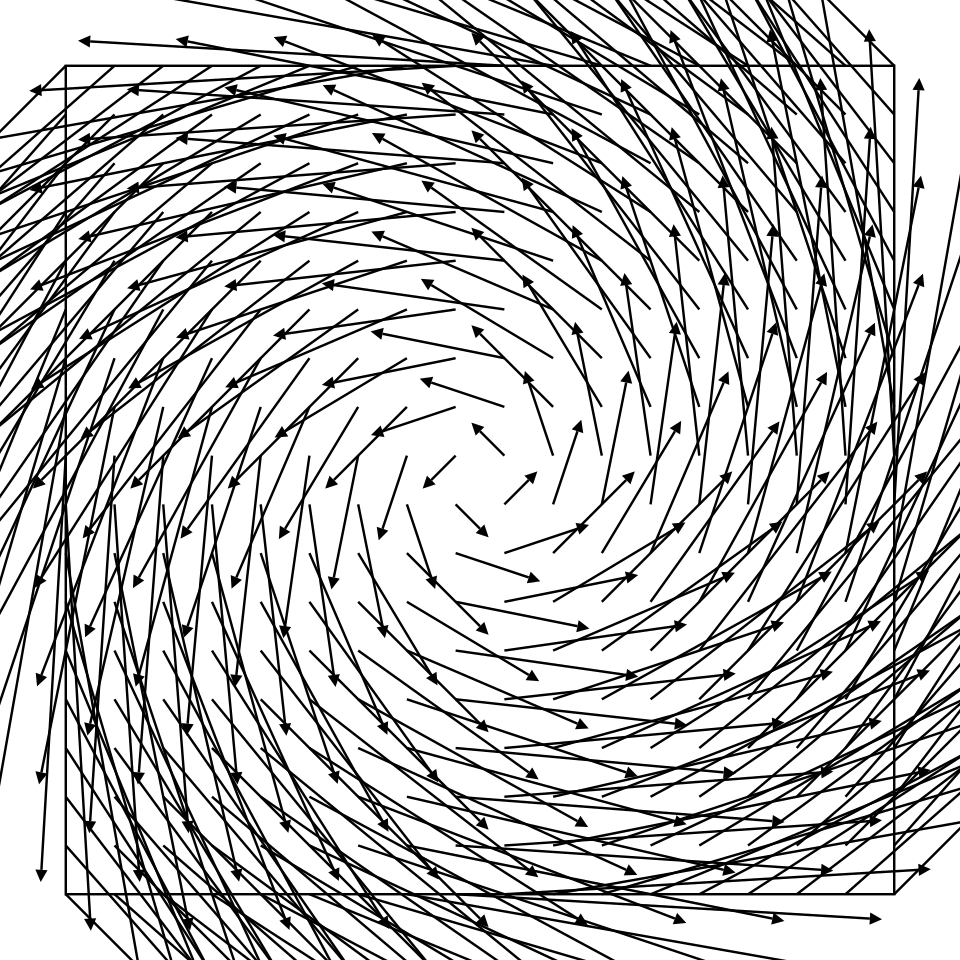 | Toute opération du calcul vectoriel, y compris le gradient , la divergence et le rotationnel . |
 1
1  2
2 Le calcul multivariable permet d'analyser les systèmes déterministes à plusieurs degrés de liberté . On utilise souvent des fonctions dont les variables indépendantes correspondent à chaque degré de liberté pour modéliser ces systèmes, et le calcul multivariable fournit des outils pour caractériser leur dynamique .
Le calcul multivarié est utilisé dans la commande optimale des systèmes dynamiques à temps continu . Il est utilisé en analyse de régression pour établir des formules permettant d'estimer les relations entre différents ensembles de données empiriques .
Le calcul multivarié est utilisé dans de nombreux domaines des sciences naturelles et sociales ainsi que de l'ingénierie pour modéliser et étudier des systèmes de grande dimension présentant un comportement déterministe. En économie , par exemple, les choix des consommateurs concernant divers biens et les choix des producteurs concernant les différents intrants à utiliser et les extrants à produire sont modélisés à l'aide du calcul multivarié.
Les systèmes non déterministes, ou stochastiques, peuvent être étudiés à l'aide d'un autre type de mathématiques, comme le calcul stochastique .